Evaluation of Elastase Inhibitory Activity
Test Report
Test Product : UMO Concentrated Solution
Test Requester : APA Corporation
Test Item : Elastase Inhibitory Activity Evaluation
Retention Period : 5 years after test completion
Report Structure
- Summary
- Test Objective
- Test Overview
- Materials and Methods
- 4.1 Test Material
- 4.2 Test Procedure
- 4.2.1 Elastase Inhibitory Activity
- Test Results
- 5.1 Elastase Inhibitory Activity
- References
1. Summary
The addition of UMO Concentrated Solution resulted in:
- A significant increase in elastase inhibitory activity compared to the control.
These results suggest that UMO Concentrated Solution has potential as an anti-aging ingredient.
2. Test Objective
To evaluate the elastase inhibitory activity of the test product and assess its potential properties for anti-aging applications.
3. Test Overview
In aged skin, signs such as wrinkles and sagging are commonly observed.The decline in skin elasticity (loss of firmness) is believed to be partly caused by elastase activity, which degrades elastin fibers produced by dermal fibroblasts.
This test evaluated the elastase inhibitory activity of the test product to explore its potential use in anti-aging cosmetics.
4. Materials and Methods
4.1 Test Material Preparation
The test product was diluted with ultrapure water (CAS No. 7732-18-5, Wako, Japan) to prepare three concentrations: 3%, 30%, and 100% for use.
4.2 Test Procedure
4.2.1 Elastase Inhibitory Activity
The effect of the test product on elastase activity was evaluated using N-Succinyl-Ala-Ala-Ala-p-Nitroanilide as the substrate.
- In a 96-well plate, combine:
- 50 μL of test product or control
- 50 μL of 1.25 μg/mL elastase enzyme (CAS No. 39445-21-1, Sigma-Aldrich, USA)
- 100 μL of N-Succinyl-Ala-Ala-Ala-p-Nitroanilide (CAS No. 52299-14-6, Sigma-Aldrich, USA)
Shake at 270 rpm for 30 seconds, then incubate at 37°C for 15 minutes.- Control: ultrapure water
- Blank: 0.05 M Tris-HCl buffer instead of enzyme
- Each condition was tested in triplicate wells.
- Shake the plate at 270 rpm for 10 seconds to mix, then measure absorbance at 415 nm (OD415) using a microplate reader.
- Calculate elastase activity and inhibition rate using the formulas:

Where:
- C: control OD415
- CB: control blank OD415
- S: test product OD415
- SB: test product blank OD415
5. Test Results
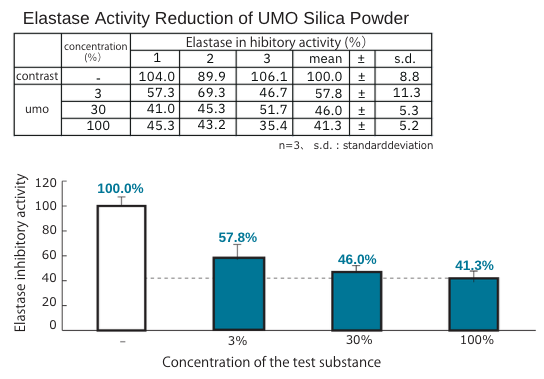
The average values and standard deviations are summarized in Table 1, and a bar graph of elastase activity is shown in Figure 1.
5.1 Elastase Inhibition Evaluation
- The elastase activity of the control was set to 100%.
- The elastase activity and inhibition rate of the test product are shown in Table 1.
6. References
- H. Motoyoshi, et al., Cosmetic Technology Journal, 31(2), 190–200, 1997.
- H. Masaki, T. Iwabuchi, T. Hirao, Protocol Collection for Cosmetic Ingredient Development, CMC Publishing, 2105, p. 347.
Table 1: Elastase Activity and Inhibition Rate of UMO Concentrated Solution

Figure 1: Elastase Activity
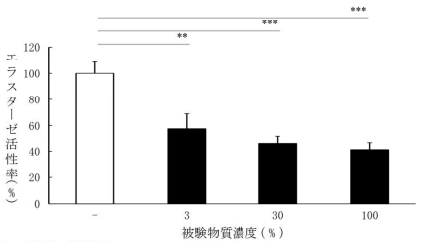
n = 3, mean ± s.d., unpaired t-test, P< 0.05, P < 0.01, P< 0.001s.d.: standard deviation
Note: This paper is translated from the following URL. The content is provided for reference on the scientific research of the raw material only. Whether APA raw materials are used or not, we hope this research will help increase understanding and awareness of body minerals.