Immune Effects of Water-Soluble Silicon (UMO) in Rats

Japan Association of Health and Medical Sciences
Health and Medical Research, No. 5
Published March 3, 2013 Reprint
1) Kenki Okada, APA Corporation Co., Ltd.. 2)Mitsuo TERASAWA, Biological Health Science Laboratory.
3)Akiko Sugawara, Sugawara Research Institute
<Abstract>
Water-soluble silicon “UMO” is an edible silicon produced using a special extraction method from crystal quartz and plant-based silicon. UMO has beneficial properties including bacteriostasis, permeability, cleansing ability, activation, and anti-inflammatory effects. In this experiment, we examined and compared the number of lymphocytes between a group of rats given water containing 1% UMO and a control group given fresh water.
The rats that drank UMO showed increased lymphocyte numbers in the thymus during early life and in the spleen during old age compared to the control group. This indicates that UMO enhances immune function in the thymus during youth and in the spleen in later life.
Received: December 18, 2012Accepted: February 2, 2013
1. Introduction
1.1 Hunza Water and Its Characteristics
In the remote mountains of northern India, now the Karakoram range in Pakistan, there is a hidden valley 2,700 meters above sea level inhabited by people who live past 100 years old without falling ill, known as the long-lived Hunza village. Dr. Patrick Flanagan revealed that the secret to their longevity was Hunza water. Water from melted glaciers passes through special mineral deposits, absorbing colloidal minerals (extremely fine mineral particles) and becoming cloudy. This water was identified as a special type of “silica.” Further biomedical research demonstrated that this colloidal particle-containing “liquid crystal colloid water” has the following characteristics:
Compared to normal water, it has lower surface tension, making it more wettable, which allows easier absorption into cells, promoting hydration, nutrient intake, and toxin elimination.
Silica-based nanocolloid particles make water alkaline and behave like expandable cages (“Backy Balls”) according to surrounding fluid pH, capturing harmful heavy metals like lead and mercury for safer excretion.
Silica nanocolloids act effectively on the blood’s “zeta potential” (negative charge). A higher zeta potential prevents red blood cell aggregation, protects cells, and facilitates removal of toxins and bacteria between cells.
Silica nanocolloids supply a large number of negatively charged hydrogen ions when in contact with water.
1.2 Water-Soluble Silicon (UMO)
Water-soluble silicon is a silicon-oxygen compound extracted by processing high-purity quartz crystals and carbonized plant fibers containing specific silicates in a special vapor dissolution system at over 2,000°C. UMO consists of micellar colloid particles with strong surface negative charges ranging from 200 μm to 1 μm, uniformly dispersed in solution. Like amorphous volcanic clay minerals such as allophane, it interacts strongly with water molecules. UMO demonstrates bacteriostatic effects (instant sterilization of Legionella, E. coli), high permeability (ultrafine subdivision at 1/2.5 billionth meter scale), cleansing ability (removing contaminants from food and the environment), activation (enhancing cell activity through provision of nutrients, oxygen, and hormones), and anti-inflammatory properties (immune-enhancing). It also has strong reducing power. The silicon crystal fully dissolves in water and can exist as a solid, powder, or liquid, allowing broad applications.
The thymus develops most during adolescence, reaching 20–30 g, but atrophies afterward. Conversely, spleen immunity is known to increase with age. This study aimed to investigate how thymus and spleen immunity change with age in rats and how UMO affects immunity.
1.3 Main Immune Cells (Lymphocytes)
Red blood cells, white blood cells, and platelets are produced in the bone marrow. White blood cells are responsible for immunity and consist of granulocytes, lymphocytes, and macrophages. Granulocytes are further divided into neutrophils, basophils, and eosinophils. Granulocytes ingest large foreign bodies like bacteria, while lymphocytes attack viruses and cancer cells. Lymphocytes include B cells (antibody production), T cells (helper, suppressor, and killer T cells), natural killer cells (NK), and thymus-derived NKT cells. Once infected by influenza (antigen), the body produces antibodies, making reinfection less likely. Killer T cells and NK cells destroy cancer cells.
Lymphocytes are produced in the bone marrow, go to the thymus for about 100 days of “education,” and then differentiate in lymph nodes and spleen. In the thymus, immature lymphocytes learn to distinguish self from non-self (bacteria, viruses, cancer cells) and mature into various T lymphocytes. Well-educated lymphocytes act as immune commanders, quickly analyzing harmful vs. beneficial cells.
The spleen recycles blood. Red blood cells are replaced roughly every 120 days. Macrophages remove old cells and release important substances like iron. Damaged cells are destroyed along with malformed or nonfunctional cells. Blood circulates through the body in about 48 seconds, connecting through peripheral vessels totaling ~100,000 km, delivering nutrients and oxygen to 60 trillion cells, and returning CO₂ and waste.
2. Experimental Methods
2.1 Experimental Animals
Eighteen 15-week-old clean male Wistar rats were divided into two groups. In Group 1 (8 rats), 4 rats received 1% UMO in distilled water (A) and 4 received distilled water (B). In Group 2 (10 rats), 5 rats received 1% UMO (A) and 5 distilled water (B). Drinking water was provided freely. Rats were fed 15 g/day of Japanese Lab MR Stock powder.
2.2 Experimental Period
Group 1: 58 days of UMO or distilled water
Group 2: 70 days of UMO or distilled water
2.3 Immune Measurement Procedures
2.3.1 Lymphocyte Isolation
All procedures were approved by the Tamagawa University Animal Committee.
At the experiment’s end, rats were anesthetized with isoflurane, and spleen and thymus were removed and weighed in 3 ml Hank’s solution.
Tissue was minced using 75 μm nylon mesh, washed in Hank’s solution, and centrifuged under specific conditions to isolate lymphocytes.
Lymphocytes were stained with Trypan Blue and counted under a microscope using a hemocytometer.
2.3.2 Lymphocyte Counting Method
Lymphocytes were counted using the formula:Cells/ml = total cells in 4 large squares × 4 (for 16 squares) × 10⁴ × 2 (dilution factor)
2.3.3 Equipment
Trypan Blue, Burker-Turk hemocytometer, optical microscope (400x). Data analyzed with t-tests.
3. Experimental Results
3.1 Average Lymphocyte Count by Drinking Period
After 58 days:
Spleen: distilled water 2.16×10⁶, UMO 2.95×10⁶
Thymus: distilled water 6.97×10⁶, UMO 1.30×10⁷
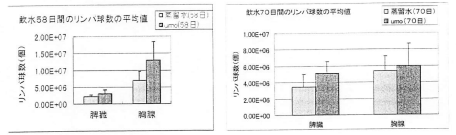
After 70 days:
Spleen: distilled water 3.48×10⁶, UMO 5.15×10⁶
Thymus: distilled water 3.36×10⁶, UMO 5.96×10⁶

UMO increased lymphocyte counts in both thymus and spleen compared to distilled water.
3.2 Lymphocyte Changes Over Time
Thymus lymphocytes decreased with rat age.
Spleen lymphocytes increased with rat age.
3.3 Lymphocyte Count per Gram of Tissue
Spleen: 58 days – distilled water 3.0×10⁶/g, UMO 3.95×10⁶/g; 70 days – distilled water 5.95×10⁶/g, UMO 9.10×10⁶/g
Thymus: 58 days – distilled water 5.86×10⁷/g, UMO 1.05×10⁸/g; 70 days – distilled water 5.57×10⁷/g, UMO 5.95×10⁷/g

Thymus lymphocytes per gram increase in youth but decrease with age; spleen lymphocytes increase with age.
4. Conclusion and Discussion
Thymus immunity is active in youth, decreasing with age, while spleen immunity increases with age. This study experimentally showed that UMO increases lymphocyte numbers in thymus and spleen, enhancing immune function. UMO may support immune function similarly to zinc supplementation.
Dr. Flanagan identified Hunza longevity as due to colloidal silica-rich water, which helps remove heavy metals, prevents blood aggregation, and improves vascular health. UMO, absorbed through the gut, may help eliminate harmful substances and improve peripheral circulation.
Cancer is the leading cause of death in Japan, and conventional therapies (surgery, chemotherapy, radiation) have side effects. UMO may help mitigate toxicity by promoting detoxification. Reactive oxygen species, generated during metabolism, damage cells; providing electrons helps prevent this damage. Silica nanocolloids act on zeta potential, suggesting UMO has beneficial physiological effects.
Acknowledgments
We thank Director Akihiro Kaneko of the Japan Silicon Application Development Institute and Professor Takeshi Aihara, Faculty of Engineering, Tamagawa University, for their support and guidance.
References
Itō M., Sugano M., Terasawa K. (2012): The Power of Silicon to Overcome Intractable Diseases, Bio Magazine.
Ushiki T. (2013): Introduction to Histology, Nankodo.
Terasawa Y., Ooi H., Okada N., Matsushima T. (2011): “Effect of Water-Soluble Silicon (UMO) on Immunity,” 24th Annual Meeting of Japan Health Psychology Society, PB-02, p.44.
Terasawa K. (2011): Improving Diseases that Do Not Respond to Cell Activation, Goma Shobo.
Nakamura J. (2011): If You Want a Peaceful Death, Avoid Medicine, Fuyusha Shinsho.
Fujino B. (trans.) (1999): The Deciphered “Fountain of Youth” – The Secret of the Longevity Kingdom Lies in Water, Dream Shobo.
Hoshino J. (2005): Advice from a Doctor Who Survived Terminal Cancer by Refusing Chemotherapy, Ascom.
Note: This paper is translated from the following URL. The content is provided for reference on the scientific research of the raw material only. Whether APA raw materials are used or not, we hope this research will help increase understanding and awareness of body minerals.