Effects on Meat Quality Improvement and Reduction of Fecal Odor

Effects on Meat Quality Improvement and Reduction of Fecal Odor by Administration of
Water-Soluble Silicon in Broilers
Junpei YAMAMOTO, Kazutoshi SUGITA, Ai MEKARU, Hisato KOBAYASHI,
Yuko YOSHINAGA, Takahiko TAKAGI, Akishi SHIRAI, Fumitoshi ASAI
Journal of Veterinary and Animal Science (JVM), Vol. 70, No. 4, April 2017, pp. 279–282
Original Article
Accepted: October 31, 2016
Abstract
This study investigated the effects of 7-week administration of water-soluble silicon in drinking water on meat quality and indole concentration in feces of broilers. In breast meat, serine and alanine were significantly increased (ρ < 0.05) in the low-dose (1%) water-soluble silicon group compared with the control group. In tenderloin meat, aspartic acid, threonine, glycine, and alanine were significantly increased (ρ < 0.05) in the high-dose (5%) group compared with the control. Additionally, indole concentration in feces showed a dose-dependent decrease with water-soluble silicon administration. These results suggest that supplementation with water-soluble silicon may be useful for improving meat quality and reducing fecal odor in broilers.
Keywords: Water-soluble silicon, meat quality, fecal odor, broiler, free amino acids
1. Introduction
Silicon (Si, atomic number 14) is one of the most abundant elements in the biological world, distributed relatively abundantly in skin and bone. Although silicon is an essential nutrient, its content in the body decreases with age. Administration of silicon to ovariectomized rats prevents bone loss, and in humans, silicon is used as a supplement to prevent postmenopausal osteoporosis. Previous studies have shown that supplementation with water-soluble silicon in mice fed a high-fat diet reduced fecal odor and suppressed fatty liver formation.
The purpose of this study was to evaluate the effects of water-soluble silicon added to drinking water, administered from hatching to 7 weeks of age, on meat quality and reduction of fecal odor in broilers.
2. Materials and Methods
1) Animals
All animal experiments were conducted at the Institute for Biological Safety Research (Kanagawa, Japan) and approved by the animal experiment committees of the Institute and Azabu University.
Thirty healthy male broiler chicks (Chunky strain) without abnormal external features, purchased from Mori Hatchery Co., Ltd., were used. The chicks were housed in a floor pen divided into 3 compartments (0.72–2.25 m² per compartment), with 10 birds per compartment.
Heating was provided by an electric brooder and livestock heat lamps. Bedding material ("Beta Chip," Japan Charles River Co., Ltd.) was replaced as necessary. Lighting was provided continuously.
From hatching to 3 weeks of age (22 days), chicks were fed a starter diet (Chicken No.1, Nippon Feed Co., Ltd.), and from 3 to 7 weeks of age (50 days), they were fed a grower diet (Chicken No.3, Nippon Feed Co., Ltd.) using trays and tubular feeders.
2) Experimental Protocol
Based on initial body weight, chicks were stratified and randomly assigned to three groups of 10 birds each:
Control group: Tap water without additives
Low-dose group: 1% (v/v) water-soluble silicon solution (umo, APA Corporation, Si = 8 mg/mL)
High-dose group: 5% (v/v) water-soluble silicon solution
Water-soluble silicon solutions were prepared in tap water and provided ad libitum from day 1 using drinking water dispensers.
3) General Observations
From hatching to 7 weeks of age (50 days), the following were observed/measured: drinking water consumption, water-soluble silicon intake, general condition (activity, appetite, feather condition, fecal characteristics), body weight, feed intake, and feed conversion ratio [feed intake (g/bird) ÷ average weight gain (g)].
4) Meat Quality Analysis
At 7 weeks of age, surviving birds were slaughtered by exsanguination, skinned, and dissected. Whole tenderloin, breast, and thigh meat were sampled individually. Breast and tenderloin meat were minced and stored in polyethylene bags at -70°C until analysis.
Methanol extracts of meat were concentrated, defatted using water and ether, and analyzed for free amino acids using a ninhydrin pre-column method on an amino acid analyzer (JLC-500/V-2, JEOL Ltd.).
5) Analysis of Fecal Odor Compounds
Feces were collected from all animals before water-soluble silicon administration (day 1) and individually at 7 weeks of age (day 49–50). Samples were collected within ~1 hour after excretion, divided into two portions, stored in glass containers, and frozen at -70°C until analysis.
Indole in feces was measured using solid-phase microextraction (SPME) and GC/MS. Approximately 20 mg of feces were weighed into 2 mL vials, sealed with Teflon septa, and kept frozen until analysis (-20°C). Volatile compounds were adsorbed onto a 100 μm PDMS SPME fiber at 40°C for 30 min and analyzed using GC/MS (Agilent GC6890/MSD5973).
6) Statistical Analysis
Data are expressed as mean ± standard error. One-way ANOVA was used, and significant differences between groups were analyzed by Tukey's multiple comparison test. Statistical significance was set at ρ < 0.05.
3. Results
1) General Observations
(1) Drinking Water and Silicon Intake:
Daily water intake per bird increased in all groups from day 1. Over 7 weeks, intake was ~15,400 mL for control and low-dose groups; high-dose group consumed ~800 mL more. Calculated total silicon intake per bird was 1,234.2 mg (low-dose) and 6,490.3 mg (high-dose), with a dose ratio of 1:5.26.
(2) Feed Intake and Feed Conversion Ratio:
Average feed intake per bird over the observation period: Control 7,325 g, low-dose 6,826 g, high-dose 7,154 g; no significant differences. Feed conversion ratio: Control 1.625, low-dose 1.565, high-dose 1.627; no significant differences.
(3) General Condition and Body Weight:
No abnormalities were observed in activity, appetite, feather condition, or feces. No significant differences in body weight were noted between groups at any time point.
2) Meat Quality Analysis
No changes in free amino acids related to sweetness or umami were observed in thigh meat. However, increases in free amino acids related to sweetness and umami were observed in breast and tenderloin meat.
Breast meat: Serine and alanine were significantly increased in the low-dose group compared with control; high-dose group showed a trend toward increase.
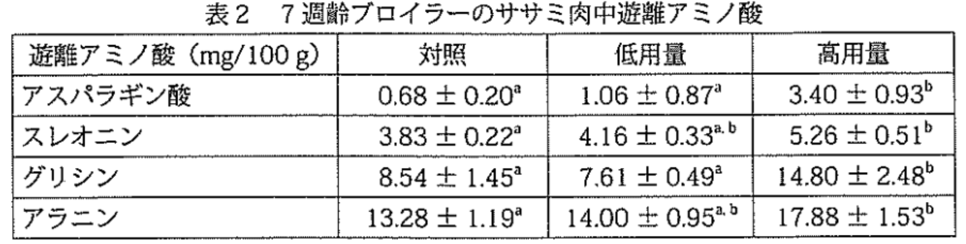
Tenderloin meat: Aspartic acid, threonine, glycine, and alanine were significantly increased in the high-dose group; aspartic acid and threonine showed dose-dependent increases.
Data are presented as mean ± standard error. Different letters (a, b) indicate significant differences (ρ < 0.05).
3) Fecal Odor Analysis
d8-toluene was used as an internal standard. Calibration curves (5–250 ng) showed linearity, with a quantification limit of 5 ng.
Indole concentration in 7-week feces decreased dose-dependently in the water-soluble silicon groups compared with control (Figure 1).

4. Discussion
The water-soluble silicon used in this study was obtained by vaporizing high-purity quartz at >2,000°C, followed by extraction with a special carbonizing agent from silicate plant fibers, yielding a silicon-oxygen solution.
Continuous administration of 1% or 5% water-soluble silicon in drinking water for 7 weeks did not cause any abnormalities, indicating safety for long-term supplementation.
Serine, alanine, threonine, and glycine contribute primarily to sweetness, and aspartic acid contributes to umami. Therefore, silicon supplementation increased sweetness in breast meat and both sweetness and umami in tenderloin meat. Differences in effective dose between meat types suggest that the response may depend on the muscle region.
Dose-dependent decreases in fecal indole concentration indicate reduction of fecal odor, consistent with previous studies in high-fat diet mice. Variation in fecal indole among broilers may be due to urine dilution unique to birds.
These results suggest the potential usefulness of water-soluble silicon as a supplement for meat-producing poultry.

References
1) Ajinomoto Co., Inc. (2003): Amino Acid Handbook, 44-51, Industrial Research Institute.
2) Jugdaohsingh, R. (2007): J. Nutr. Health Aging. 11, 99-110.
3) Rico, H., Gallego-Lago, J.L., Hernández, E.R. et al. (2000): Calcif. Tissue Int. 66, 53-55.
4) Sugita, K., Kawai, A., Shirai, A. et al. (2015): Bushichoku Shinpo 68, 843-847.
Beneficial Effect of Water-Soluble Silicon on the Meat Quality and Fecal Odor of Broiler ChickensYamamoto, J., Sugita, K., Ai, M. Hisato KOBAYASHI *3,
Yuko YOSHINAGA 1, Yukihiko TAKAGI 2, Mitsuyuki SHIRAI 4, Fumitoshi ASAI 4
*1 Laboratory of Food Analysis Chemistry, School of Life and Environmental Science, Azabu University,Sagamihara, Kanagawa 252-5201, Japan
*2 Laboratory of Veterinary Public Health I, School of Veterinary Medicine, Azabu University,Sagamihara, Kanagawa 252-5201, Japan
*3 Research Institute for Animal Science in Biochemistry and Toxicology,Sagamihara, Kanagawa, 252-0132, Japan
*4 Laboratory of Pharmacology, School of Veterinary Medicine, Azabu University,Sagamihara, Kanagawa 252-5201, Japan.
Note: This paper is translated from the following URL. The content is provided for reference on the scientific research of the raw material only. Whether APA raw materials are used or not, we hope this research will help increase understanding and awareness of body minerals.